


- Infection Control
Shop Our Top Infection Control Products
- Offers and Promotions


What is a dental curing light?
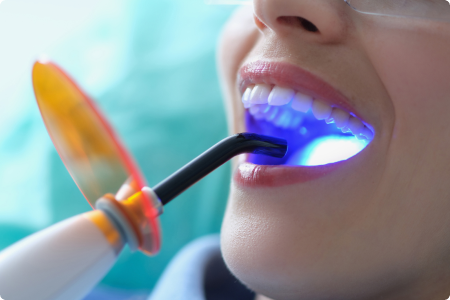
Curing light output power
A key feature of a curing light is the output power, often referred to as irradiance or brightness. Measured in milliwatts per square centimetre (mW/cm2), output power is the amount of light that the curing light is able to produce. LED curing lights are known for generating output powers of greater than 1,000 mW/cm2 and can cure most materials. Some LED curing lights can reach a light intensity of 2,000mW/cm2 which enables the curing of thicker materials and a wider range of shades and opacities.
According to Ivoclar Vivadent, at least 1,000 mW/cm2 is needed to polymerize composite materials in 10 seconds through a dental structure in indirect restoration. However, for direct restorations, only 400 mW/cm2 of output power is required for proper light-curing. Higher brightness means a higher generation of heat. The best dental curing lights have a low wattage requirement and offer a long lifespan without deterioration of output power. Light intensity can be measured and monitored using a radiometer to ensure consistency.
Curing light output wavelength
Along with output power, output wavelength is the key consideration. It is essential that the wavelength of the curing light being used is compatible with the photoinitiator used in your restorative material. Even the slightest variation between composite and wavelength compatibly can affect polymerization and restoration longevity.
Wavelengths are measured in nanometres (nm). LED curing lights tend to have a spectrum range of either 440nm - 490nm or a broader range of 390nm - 490nm. Most composites are activated by light emitted at around 468 nm. Other composites require initiation in the 429 nm range.
All light-cured materials have specific instructions which should be followed to ensure proper polymerization.
Curing light output wavelength
Along with output power, output wavelength is the key consideration. It is essential that the wavelength of the curing light being used is compatible with the photoinitiator used in your restorative material. Even the slightest variation between composite and wavelength compatibly can affect polymerization and restoration longevity.
Wavelengths are measured in nanometres (nm). LED curing lights tend to have a spectrum range of either 440nm - 490nm or a broader range of 390nm - 490nm. Most composites are activated by light emitted at around 468 nm. Other composites require initiation in the 429 nm range.
All light-cured materials have specific instructions which should be followed to ensure proper polymerization.
Programmes and modes
Modern LED curing lights come with built-in programmes and curing cycles to increase or decrease output, and improve polymerization efficiency. Common curing modes include full power, “ramp” and “pulse”. Low curing settings can help reduce shrinkage and be gentler to pulp tissue, while modes like “ramp” start off at a lower output and then slowly increase to a higher output. Most curing lights can be pre-set to a curing time of 5, 10, 15 or 20 seconds. This removes the need for manual timekeeping.
Curing light tip diameter
The diameter of the tip can have a major influence on polymerization. Tip diameter sizes are usually 4, 8 or 10mm.
8mm tips can meet the requirements of most restorations. 10mm tips that cover the entire restoration should be considered when placing sealants or resin composites on the occlusal surfaces of permanent molars.
Studies have shown that 4mm tips have a greater depth of cure compared to other diameters and can produce greater hardness.
Leaving even a small distance between the tip and the curing material will lessen the amount of light reaching the restoration, and may affect the quality of cure.
Curing light tip diameter
The diameter of the tip can have a major influence on polymerization. Tip diameter sizes are usually 4, 8 or 10mm.
8mm tips can meet the requirements of most restorations. 10mm tips that cover the entire restoration should be considered when placing sealants or resin composites on the occlusal surfaces of permanent molars.
Studies have shown that 4mm tips have a greater depth of cure compared to other diameters and can produce greater hardness.
Leaving even a small distance between the tip and the curing material will lessen the amount of light reaching the restoration, and may affect the quality of cure.
Other considerations
Ordering Table
A simple definition of CAD/CAM dentistry is the use of digital software to design and manufacture dental restorations and prostheses. CAD stands for computer-aided design and CAM stands for computer-aided manufacturing. The technology can be used to create crowns, dentures, inlays, onlays, bridges and veneers among other things. The speed of the CAD/CAM process allows for dental prosthetics to be designed, manufactured and delivered to the patient in quick time, sometimes the same day. The wider system of using computer assisted technologies to produce restorations is known as CEREC (Chairside Economical Restoration of Aesthetic Ceramics).
Shop Dental LED Curing Lights
Share


