


- Infection Control
Shop Our Top Infection Control Products
- Offers and Promotions


Manual cleaning of dental instruments can be time-consuming and an ineffective form of pre-sterilization if not performed correctly. Ultrasonic baths, also known as ultrasonic cleaners, are a great way of minimising the need for manual cleaning and improving overall efficiency.
What is an ultrasonic bath?
An ultrasonic bath is a stainless-steel machine used to clean items with high frequency sound waves. In a dental practice ultrasonic cleaners are traditionally used for the cleaning and reprocessing of dental instruments, such as mirrors, probes and scalers.
How does ultrasonic cleaning work?
Ultrasonic cleaning uses ultrasound to safely enhance and intensify the cleaning process. The sound waves created are incredibly powerful and create masses of microscopic bubbles in the liquid, known as cavitation bubbles. These bubbles grow as they vibrate and eventually implode. This process creates a scrubbing effect within the liquid which destroys and separates all surface contamination on any items the liquid comes into contact with, including intricate areas like hinges. This process usually takes between 5-10 minutes but varies depending on the size of the load and competency of the cleaner. Once the cycle has finished the instruments should be removed, rinsed under cold water and left to dry prior to being sterilized in an autoclave.
What is degassing?
It is important to degas the ultrasonic bath prior to using it for the first time each day. This should be done once it has been filled with fresh water and the correct amount of instrument cleaner has been added. Degas cycles are carried out to ensure to that the oxygen contained within the fresh water and detergent does not inhibit the cavitation effect and compromise the cleaning.
Is ultrasonic cleaning mandatory for dentists?
Ultrasonic cleaners are not a mandatory requirement for dental practices but are widely considered the most effective form of pre-sterilization cleaning over washer-disinfectors and manual cleaning. This can be accredited to ultrasonic cleaning’s ability to penetrate complex and hinged instruments safely and thoroughly, and the speed at which this is achieved.
What to consider when buying an ultrasonic cleaner
In line with HTM 01-05 guidance on decontamination in primary dental care practices, the following characteristics should be considered when buying an ultrasonic cleaner.
Share


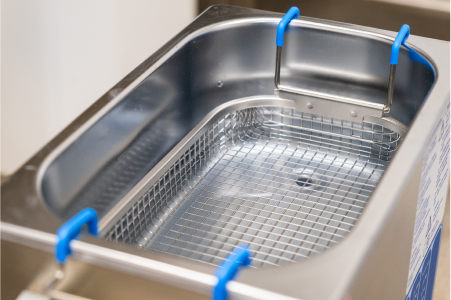
A reservoir drainage facility that does not affect performance and does not leave pools of fluid in the reservoir
Choosing an ultrasonic bath with a built-in drain can make the draining process easier and safer for staff. Ultrasonic cleaners not fitted with a draining facility require a staff member to lift the bath up to drain the water. Doing this can be awkward, dangerous and increases the risk of cross contamination.A hinged auto-locking lid that prevents interaction with the load once the ultrasonic equipment is in use
This is one of the most important features that any ultrasonic cleaner can have. Lockable lids ensure that dental instruments cannot be loaded or taken out whilst the cycle is in operation. This is very important for validation purposes as it eliminates the chances of invalidating a cycle by opening the lid. Lockable lids also help to minimises noise and prevent airborne contaminates escaping the cleaner.An automatic printer and data-logger (this can be integrated)
All ultrasonic cleaners should incorporate some means of validating the cycle and one of the easiest ways to do this is with an integrated printer and data logger. It is important that time and date, cycle type, unique cycle number, duration of cycle and the equipment serial number can all be recorded. In addition to this, all tests and maintenance should be recorded in a suitable logbook and kept for a minimum of two years for audit purposes. Infection control specialists Dentisan produce logbooks specially designed for ultrasonic cleaning that provide daily, weekly, quarterly and annual test sheets for an ultrasonic cleaner over 12 months.Thermostatic control
Dental instrument cleaning should occur at no higher than 45°C to prevent the baking and coagulation of bioburden and proteins on the instruments. Most modern ultrasonic cleaners allow you to control the temperature and adjust if necessary. The unit’s display screen should ideally show the minimum and maximum temperatures and display a warning if the temperature gets too high or too low. Other settings that are often user-adjustable include cycle time, ultrasonic power and frequency.Kent Express Recommends
The ultrasonic bath you choose for your practice will depend on several variables including the number of chairs you have, budget, staff numbers and even worktop space. An ultrasonic cleaner that offers excellent value and strikes a good balance between cost and quality is the BA Ulticlean BASE410 Ultrasonic Bath. This is a 4-litre capacity ultrasonic bath with optional heat. Wave technology gives a uniform cleaning pattern that eliminates hot spots and weak areas, giving constant power and output.
Other features include:
- Smooth, quiet operation and easy-to-clean housing
- Hinged automatic locking lid - prevents opening during cycle
- Easy-to-use built-in drain
- Touchpad controls with 60-minute timer
- 1-year warranty
- Accessory kit available (includes Full Basket, Positioning Cover Half and Beakers 600ml x 2)
Call your account manager for more details or to purchase, or alternatively call 0800 028 1181 (Option 1).
Kent Express Recommends
The ultrasonic bath you choose for your practice will depend on several variables including the number of chairs you have, budget, staff numbers and even worktop space. An ultrasonic cleaner that offers excellent value and strikes a good balance between cost and quality is the BA Ulticlean BASE410 Ultrasonic Bath. This is a 4-litre capacity ultrasonic bath with optional heat. Wave technology gives a uniform cleaning pattern that eliminates hot spots and weak areas, giving constant power and output.
Other features include:
- Smooth, quiet operation and easy-to-clean housing
- Hinged automatic locking lid - prevents opening during cycle
- Easy-to-use built-in drain
- Touchpad controls with 60-minute timer
- 1-year warranty
- Accessory kit available (includes Full Basket, Positioning Cover Half and Beakers 600ml x 2)
Call your account manager for more details or to purchase, or alternatively call 0800 028 1181 (Option 1).